




Emergency Lighting
Emergency Lighting Installation, Retrofit and Testing
Emergency lighting is the battery-backed illumination that switches on automatically the moment normal power fails, keeping the means of egress (corridors, stairwells, exit doors) visible long enough for occupants to get out. In a Metro Vancouver commercial or strata building that means unit equipment (the twin-head fixtures trades call bug eyes), remote heads reaching the far end of a stairwell, running-man exit signs over every exit door, and in larger buildings a central inverter. Poseidon Fire Protection designs, installs, retrofits and load-tests emergency lighting for general contractors, property managers, strata councils and developers. You receive a system that matches the reviewed drawings, a written test record, and a priced deficiency list for anything that will not hold its load.

Unit Equipment, Remote Heads and Central Inverters
Unit equipment is a self-contained emergency lighting fixture that carries its own sealed battery, charger and lamp heads, so it keeps working independently of the building’s power supply at the instant that supply fails.
Unit equipment is the workhorse of low-rise commercial, industrial and strata buildings. Each unit is fed from the normal lighting circuit it serves, holds its sealed battery on trickle charge, and on loss of that circuit transfers its lamp heads onto DC. Because every unit is independent, a fault takes out one fixture rather than a floor, and because every unit has its own battery, every unit is its own maintenance item.
Remote heads extend a unit’s coverage without adding another battery: lamp heads wired back to the DC circuit of a parent unit to light a stair landing, an electrical room or a corridor leg the parent cannot reach. A central inverter takes the opposite approach: one battery plant on the life-safety panel feeding designated fixtures throughout the building. It concentrates maintenance in one room, which property managers like, and concentrates risk in one room, which is why the choice belongs on the drawings rather than on the job site.
Exit Signs and Running-Man Pictograms
A running-man exit sign is an internally illuminated pictogram face that marks an exit door or a change of direction along the path of egress, and stays lit on its own battery when the building loses normal power.
The pictogram face (the white running figure on green) replaced text-only EXIT lettering as the Canadian standard because a symbol reads across languages and reads through smoke at a distance lettering does not. Older Metro Vancouver buildings are still full of red text signs, and a sign that is not code-current is a deficiency an inspector will write up.
Exit signs are emergency lighting, not signage: behind the pictogram face sit a sealed battery, a charger and a transfer relay, and each sign is tested the way unit equipment is tested. Combination units pair a running-man face with two lamp heads on one battery, the usual answer above a rear exit door where the corridor also needs light. Poseidon supplies and installs exit signage on new construction and tenant improvements, and runs retrofit programmes that swap text-only signs to pictogram faces across a portfolio.
Inside the Fixture: Sealed Battery, Charger and Transfer Relay
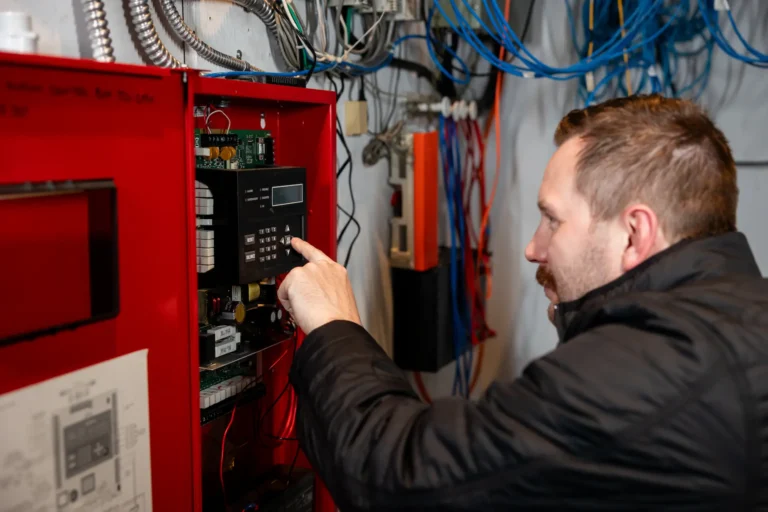
The transfer relay is the component inside an emergency lighting unit that senses loss of normal AC supply and switches the lamp heads onto the sealed battery, and it is the part that fails silently, because a building with a dead relay looks perfectly normal until the power goes out.
An emergency lighting unit is a small, predictable machine: a sealed battery, a charger holding it at float, a transfer relay, lamp heads, and increasingly a self-test module that exercises the chain and reports faults on a status LED. Everything in that chain is a wear item. The battery is the consumable: sealed lead-acid and nickel-cadmium cells lose capacity with age and heat, and a battery reading full voltage at rest can still collapse the moment lamp heads are put on it. That is the entire reason the test is a load test and not a voltage check.
The rest of the failures are mechanical and unglamorous, and Poseidon carries the common parts on the truck, so a unit that fails during testing is usually repaired on the same visit rather than becoming a second mobilisation.
What we repair and replace
- Sealed lead-acid and nickel-cadmium batteries that no longer carry the load
- Chargers and transfer relays that no longer transfer
- Halogen lamp heads converted to LED to cut the draw on the battery
- Failed self-test modules and their status indicators
- Corroded remote-head wiring in parkades, loading bays and stairwells
- Text-only EXIT signs replaced with running-man pictogram faces
Emergency Lighting and the Means of Egress
The means of egress is the continuous, unobstructed path from any point in a building to a public thoroughfare, and emergency lighting is the system that keeps that path usable when normal power is gone.
Coverage is not a matter of hanging a unit wherever there is a spare junction box. The BC Fire Code requires emergency lighting along the exit routes (corridors, stairwells, ramps, exit doors and the principal routes serving open floor areas) and in the rooms a building depends on in an emergency, such as electrical and mechanical rooms and the fire alarm control panel location. The equipment is built to CSA standards; where it goes, and how much light lands on the floor, comes out of the photometric layout.
That layout is where most deficiencies are born. A demising wall dropped into an open floor plate cuts a corridor off from the unit that used to light it; a renovation that relocates an exit door leaves the running-man sign pointing at drywall. Poseidon reviews the egress path against what is actually installed, marks the gaps, and prices the fixtures needed to close them, before an inspector does it for you.
Load Testing, Self-Test Modules and Deficiency Reporting
An emergency lighting load test is the test in which a unit is cut off from normal supply and made to run its lamp heads on battery alone, for the duration the BC Fire Code requires, to prove the battery will carry the load when the building goes dark.
Emergency lighting sits on a fixed inspection cycle, and the load test is the part of that cycle that matters, because it tests the thing that fails. A technician isolates the unit, runs it out on battery, confirms the lamp heads stay lit and correctly aimed, that remote heads transfer with their parent unit, that exit sign faces stay illuminated, and that the unit recharges afterward. Anything that will not hold the load goes on the deficiency list with its battery type named and the replacement priced.
Self-test modules automate the exercise but do not remove the obligation: someone still has to walk the building, read the indicators and produce a record. That record is what Poseidon hands over: a written result for every unit, remote head and exit sign, keyed to a location. It is the document your insurer and the authority having jurisdiction ask for, and it is why emergency lighting is usually folded into a broader inspection, testing and maintenance programme rather than chased on its own.

Installation, Retrofit and Turnover
An emergency lighting retrofit is the replacement of existing unit equipment, remote heads and exit signs in an occupied building, staged so that tenants, residents and trades are not displaced while it happens.
On new construction, Poseidon works to the reviewed drawings alongside the electrical contractor: fixtures installed, remote heads pulled, exit signs hung, everything verified and load-tested before turnover, with the test record delivered into the O&M manual so the general contractor is not chasing paper at occupancy. On tenant improvements the job is usually re-establishing coverage the new layout broke: the item that quietly holds up a final inspection.
In occupied strata and commercial buildings, retrofit work is scheduled around residents and priced by fixture, so a strata council can stage it across budget years. Poseidon is ASTTBC-registered, COR certified, carries WorkSafeBC coverage in good standing and holds commercial general liability insurance and bonding capacity; a certificate of insurance and clearance letter are provided on request. We cover Vancouver, Burnaby, Surrey, Richmond, Coquitlam, Port Coquitlam, Port Moody, New Westminster, Langley, Maple Ridge, Delta, North Vancouver and Abbotsford, and up the Sea to Sky corridor to Squamish, Whistler and Pemberton.
Scopes we take on
- New construction: install to the reviewed drawings, verified and documented at turnover
- Tenant improvements where new demising walls or relocated exits break existing coverage
- Retrofit of text-only EXIT signs to running-man pictogram faces across a portfolio
- LED conversion of halogen lamp heads to reduce battery draw
- Central inverter installation and connection of designated egress fixtures
- Deficiency correction after a failed inspection, with a re-test and an updated record
Frequently Asked Questions
Who is responsible for emergency lighting in a strata building?
The BC Fire Code puts maintenance of a building’s fire protection systems on the owner, and in a strata the corridors, stairwells, parkade and lobby are common property, so the obligation sits with the strata corporation, normally discharged through its property manager. Individual owners are not testing the bug eyes outside their doors. In practice the council needs a contractor on a fixed cycle and a test record it can produce for an insurer or a general meeting.
What is the difference between unit equipment and a central inverter?
Unit equipment is a self-contained fixture with its own sealed battery and charger, so each unit stands alone; a central inverter is a single battery plant feeding AC to designated egress fixtures across the building. Unit equipment is cheaper to install and fails one fixture at a time. A central inverter centralises maintenance and lets egress fixtures look like normal architectural lighting, which is why it appears in high-rise and higher-finish buildings.
Do LED emergency lights still need load testing?
Yes. LED lamp heads draw less current and run longer on the same battery, but the battery, charger and transfer relay are unchanged and they are what fail. A load test is the only test that proves the battery still carries the lamp heads for the required duration; a voltage reading on a rested battery will pass a unit that would die within minutes under load.
Can we replace old text EXIT signs with running-man signs across a whole building?
Yes, and it is one of the most common retrofit scopes we run for property managers and strata councils. The pictogram face is the current Canadian standard and text-only signs get written up on inspection. We price the swap by fixture, work after hours where the building is occupied, and hand back an updated equipment inventory and test record.
Our emergency lighting failed inspection and we have an occupancy date: how does that get cleared?
It gets cleared by correcting each deficiency, re-testing the affected units and issuing an updated test record the authority having jurisdiction will accept. Most failures are batteries, transfer relays, or coverage gaps left by a late layout change, and the first two are usually fixed off the truck. Tell us the occupancy date when you call and we will scope the correction against it.
Do you service emergency lighting outside Metro Vancouver?
Yes, Poseidon covers Metro Vancouver, the Fraser Valley and the Sea to Sky corridor, including Squamish, Whistler and Pemberton. Portfolio clients are scheduled by route so several buildings are tested in one mobilisation, which is how a multi-site property manager keeps the cost per building down.
Related Fire Protection Services
Emergency lighting is one half of what gets people out of a building; the other half is being told to leave. Poseidon also delivers fire alarm installation, and folds emergency lighting load testing into a single inspection and testing programme alongside your sprinkler, alarm and backflow assets. If construction work has knocked a building’s egress lighting out, that is an impairment: see 24-hour emergency service. The fixtures, their locations and their maintenance schedule all belong in your fire safety plan.
Qualified, Insured, Prequalified
Poseidon Fire Protection is an ASTTBC-registered fire protection contractor whose sprinkler fitters hold Red Seal certification.
Areas We Service
Poseidon Fire Protection is a Port Coquitlam fire protection contractor serving commercial, strata and industrial properties across Metro Vancouver, the Fraser Valley and the Sea to Sky corridor.
- Metro Vancouver: Vancouver, Burnaby, Surrey, Richmond, Coquitlam, Port Coquitlam, Port Moody, New Westminster, North Vancouver, Delta
- Fraser Valley: Langley, Maple Ridge, Abbotsford
- Sea to Sky: Squamish, Whistler, Pemberton

Get emergency lighting scoped, installed and documented
Send us the drawings, the address, or the deficiency notice you have been handed. You receive a fixture-by-fixture quotation, an installation or retrofit scheduled around your tenants, and a written test record naming every unit, remote head and exit sign: the document your insurer and the authority having jurisdiction will ask to see. Certificate of insurance and WorkSafeBC clearance letter provided on request.