




Backflow Prevention
Backflow Prevention Assembly Installation & Testing
A backflow prevention assembly is a testable mechanical device installed at a cross-connection to stop non-potable water from reversing out of a building and back into the public drinking water supply. Poseidon Fire Protection installs, tests, repairs and certifies backflow prevention assemblies on fire, domestic and irrigation service connections for general contractors, developers, property managers and strata councils across Metro Vancouver and the Fraser Valley. Every test is completed by a certified tester and filed with the municipality on its own test form, so the compliance record closes instead of sitting open.
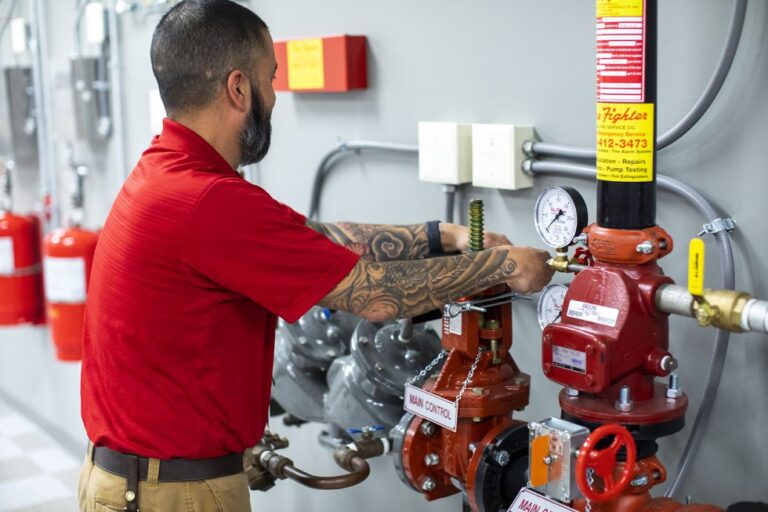
Backflow, Backpressure and Backsiphonage
Backflow is the reversal of flow in a water line, driven either by backpressure – when pressure inside the building exceeds pressure in the main – or by backsiphonage, when supply pressure drops and the main siphons water backwards out of the building.
A fire sprinkler system is a textbook cross-connection. It holds a large volume of water that has stood motionless inside steel pipe for years, sometimes dosed with antifreeze, and it is connected to the same municipal main that feeds drinking fountains. A watermain break, a hydrant opening, a fire pump starting, or a booster pump on the building side can invert the pressure differential across that connection. When it inverts, the water in the sprinkler system has somewhere to go, and the only thing standing between it and the potable supply is the backflow prevention assembly.
Cross-connection control is the discipline of finding those connections and protecting them. Premise isolation means protecting the whole property at the service connection, where the water enters the building; zone and fixture isolation protect a floor, a tenancy or a single piece of equipment further inside. Metro Vancouver municipalities enforce premise isolation through their own bylaws, and it is the connection most often assumed to be somebody else’s problem.

Your Fire Service Connection Needs an Assembly Too
A fire service connection is a cross-connection like any other, and premise isolation bylaws in Metro Vancouver require a backflow prevention assembly on it – not only on the domestic line.
The Surrey Cross Connection Control By-law No. 17988 is explicit. Section 23 requires premise isolation backflow preventers on “each of the domestic, fire and irrigation service connections” for new construction, and section 24 pulls existing buildings in as well: alterations of $400,000 or more trigger premise isolation on all three connections. Port Coquitlam’s Building and Plumbing Bylaw No. 3710 requires, at section 25.1, that cross connections be protected with a CSA-listed backflow prevention device meeting CSA B64.10. The fire line is not an exception to cross-connection control. It is one of the three connections the bylaw names first.
It is also the connection that falls through the gap. The plumbing consultant scopes the domestic assembly; the sprinkler contractor scopes the sprinkler system; the assembly sitting between the main and the riser belongs to neither, and turns up as a change order or an occupancy hold. Poseidon scopes both because we install both. That matters at the valve as much as on paper: the shutoff valves on a fire-line assembly are part of the sprinkler system’s water supply, so closing one to service the device takes the sprinkler system out of service and creates an impairment that has to be tagged, watched and restored.
The Parts of a Backflow Prevention Assembly
A backflow prevention assembly is built from two independently acting check valves, an inlet and an outlet shutoff valve, and the test cocks that let a certified tester prove each internal component still holds.
The check valves do the work. Each is spring-loaded to close against reverse flow, and each must hold on its own, because the assembly is designed on the assumption that one of them will eventually foul. The shutoff valves isolate the assembly for testing and repair. The test cocks are small tapped ports positioned between and around the checks, and they are the reason the device is called an assembly rather than a valve: a differential pressure gauge connects to them, and the tester reads whether each check still seats within tolerance. A device with no test cocks cannot be proved and cannot be certified.
A reduced pressure assembly adds a relief valve between the two checks, which discharges the zone between them to atmosphere the instant it loses its pressure differential – a fail-safe that dumps suspect water on the floor rather than into the main, and which therefore needs an air gap and a floor drain sized for full relief discharge. A detector assembly adds a metered bypass line: a small bypass meter registers the low, continuous flow that indicates a leak or an unauthorised tap on a fire line, without registering fire flow.
Assembly components we install, test and rebuild
- First and second check valves
- Relief valve (reduced pressure assemblies)
- Inlet and outlet shutoff valves
- Test cocks
- Bypass meter (detector assemblies)
- Air gap, drain and freeze protection or enclosure

RPZ, DCVA, DCDA, RPDA and PVB
The class of backflow prevention assembly is selected from the degree of hazard the connection presents – how harmful the water on the building side would be if it reversed into the drinking water main.
A double check valve assembly (DCVA) is two check valves in series, and it is used where the hazard is a nuisance rather than a health risk, such as a sprinkler system holding nothing but water. A reduced pressure zone assembly (RPZ, or RP) is a double check with a relief valve between the checks, and it is the assembly for health-hazard connections – including a fire system carrying antifreeze or foam additives, because those chemicals must never be able to reach the main. The rule of thumb procurement teams should hold onto is simple: the more dangerous the water on your side of the connection, the more the assembly must be able to fail loudly rather than quietly.
Detector assemblies are the same two devices with a metered bypass. A double check detector assembly (DCDA) and a reduced pressure detector assembly (RPDA) are what fire service connections normally get, because the bypass meter distinguishes a slow leak from a fire event on a line that is otherwise expected to sit at zero flow for years. A pressure vacuum breaker (PVB) protects against backsiphonage only, not backpressure, and is common on irrigation. Selecting the class is a design decision with hydraulic consequences: every assembly imposes a pressure loss, and on a fire line that loss lands directly in the sprinkler system’s hydraulic calculation.
Installation, Testing and the City Test Form
A backflow test is a field procedure in which a certified tester connects a differential pressure gauge to the assembly’s test cocks and proves that each check valve – and, on a reduced pressure assembly, the relief valve – still operates within tolerance.
The device is only half the deliverable. The filed test report is the other half, and it is the half that satisfies the municipality. Port Coquitlam’s Bylaw No. 3710 states at section 27 that “All backflow prevention devices are to be tested annually, commencing on the final inspection date for the device,” and that “A certified tester must complete the annual test and submit the results to the City of Port Coquitlam on the City’s test form with the applicable fee.” Surrey’s by-law requires field testing annually and, critically for construction schedules, within 14 days of a new installation or replacement – so a brand-new assembly left untested for a month is already non-compliant. Surrey requires that testers hold BCWWA certification.
Poseidon installs the assembly, tests it inside the required window, rebuilds or replaces failed checks and relief valves, retests, and submits the result to the municipality on its own form with its fee. What the general contractor gets is a passed test on file before occupancy. What the property manager gets, every year afterwards, is a passed test report and a closed file rather than a letter from the city.
Who Cross-Connection Control Is For
Cross-connection control is a legal obligation of the property owner, which in practice makes it the general contractor’s problem during construction and the property manager’s or strata council’s problem for the rest of the building’s life.
For a general contractor on new construction, premise isolation is an occupancy item on three lines at once – domestic, fire and irrigation – and the fire line is the one most likely to be missing from the plumbing scope. For a developer or an owner planning a major renovation, the threshold matters: in Surrey, alterations of $400,000 or more trigger premise isolation on all three service connections, which means a substantial tenant improvement can pull backflow prevention into a budget that never contemplated it. For a property manager or strata council, the obligation is annual and it is enforced. Under Surrey’s by-law, offences carry a fine of not less than $100 and not exceeding $10,000, with separate fines for each day the offence continues.
Poseidon Fire Protection has operated from Port Coquitlam since 2019 and serves commercial, strata and industrial properties across Vancouver, Burnaby, Surrey, Richmond, Coquitlam, Port Coquitlam, Port Moody, New Westminster, Langley, Maple Ridge, Delta, North Vancouver and Abbotsford, and up the Sea to Sky to Squamish, Whistler and Pemberton. We are COR certified, our WorkSafeBC coverage is in good standing, and we carry commercial general liability insurance and bonding capacity – certificate of insurance and clearance letter provided on request.
How a Backflow Assembly Fails
A backflow assembly fails when debris, corrosion or wear stops a check valve from seating, and on a reduced pressure assembly the fail-safe is loud and visible: the relief valve opens and discharges water onto the floor.
Continuous relief discharge is the classic call, and it almost always means a fouled first check or a fluctuating supply pressure – not a nuisance to be silenced by closing a valve. Freezing is the second: an assembly installed outdoors or in an unheated room without an enclosure or heat trace will crack, and it will crack on the coldest night of the year. An RPZ installed without a drain sized for full relief discharge floods a mechanical room the first time it does its job. A double check installed on a domestic service turns the building’s plumbing into a closed system, so thermal expansion has nowhere to go and needs an expansion tank.
The failure specific to fire lines is quieter and far more serious. Someone closes the assembly’s shutoff valve to stop a drip, and the sprinkler system loses its water supply without a single alarm being raised unless that valve is supervised. A failed annual test carries its own consequence: the device must be repaired and retested, and an assembly left failed is an offence the municipality can fine for every day it continues.
Frequently Asked Questions
Does a fire sprinkler system need a backflow preventer?
Yes – in Metro Vancouver municipalities the fire service connection is treated as a cross-connection requiring premise isolation. Surrey’s Cross Connection Control By-law No. 17988 requires premise isolation backflow preventers on “each of the domestic, fire and irrigation service connections” for new construction. Fire lines normally receive a detector assembly (a DCDA or an RPDA) so the metered bypass can distinguish a slow leak from a fire event.
How often does a backflow prevention assembly have to be tested?
Annually. Port Coquitlam’s Bylaw No. 3710 requires that “all backflow prevention devices are to be tested annually, commencing on the final inspection date for the device,” and that a certified tester submit the results to the City on the City’s test form with the applicable fee. Surrey additionally requires a device to be field tested within 14 days of a new installation or replacement.
What is the difference between a DCVA and an RPZ?
A double check valve assembly (DCVA) is two check valves in series and is used where a reversal would be a nuisance rather than a health hazard. A reduced pressure zone assembly (RPZ) adds a relief valve between the checks that discharges suspect water to the floor rather than into the drinking water main, and it is required where the hazard is a health hazard – including fire systems that carry antifreeze or foam additives. An RPZ needs an air gap and a drain sized for full relief discharge.
Why is our renovation suddenly triggering backflow prevention?
Because bylaws attach premise isolation to alterations, not only to new construction. In Surrey, alterations of $400,000 or more trigger premise isolation on the domestic, fire and irrigation service connections. A large tenant improvement or building upgrade can therefore bring backflow prevention into a project that never budgeted for it, which is why it belongs in the scope review at design stage.
What happens if we miss the annual test?
The municipality enforces it. Under Surrey’s Cross Connection Control By-law, offences carry a fine of not less than $100 and not exceeding $10,000, with separate fines for each day the offence continues. The practical consequence for a property manager is that a missed test does not stay a paperwork problem for long.
Who is allowed to test a backflow assembly?
A certified tester. Port Coquitlam’s bylaw requires that a certified tester complete the annual test and submit the results to the City on the City’s test form with the applicable fee, and Surrey requires testers to hold BCWWA certification. Poseidon performs the test, rebuilds or replaces failed checks and relief valves, retests, and files the result with the municipality.
Related Fire Protection Services
Backflow prevention on a fire line is part of the same water supply as the riser it feeds, which is why we scope it alongside fire sprinkler installation rather than as an afterthought – the pressure loss across the assembly lands directly in the sprinkler system’s hydraulic calculation. The annual test sits in the same compliance file as your fire inspections and ITM, and a shutoff valve closed on a fire-line assembly is a sprinkler impairment that needs emergency response.
Qualified, Insured, Prequalified
Poseidon Fire Protection is an ASTTBC-registered fire protection contractor whose sprinkler fitters hold Red Seal certification.
Areas We Service
Poseidon Fire Protection is a Port Coquitlam fire protection contractor serving commercial, strata and industrial properties across Metro Vancouver, the Fraser Valley and the Sea to Sky corridor.
- Metro Vancouver: Vancouver, Burnaby, Surrey, Richmond, Coquitlam, Port Coquitlam, Port Moody, New Westminster, North Vancouver, Delta
- Fraser Valley: Langley, Maple Ridge, Abbotsford
- Sea to Sky: Squamish, Whistler, Pemberton

Get your backflow assemblies installed, tested and filed
Send us your service connection details or your last test report and Poseidon Fire Protection will return a scoped quote for installation, annual testing, or repair and rebuild of your existing assemblies – covering the fire, domestic and irrigation connections together. You receive a passed test report from a certified tester, filed with your municipality on its own form, and a closed compliance file. Certificate of insurance and WorkSafeBC clearance letter provided on request.