




Port Coquitlam, BC
Backflow Prevention Assembly Testing in Port Coquitlam
A backflow prevention assembly is a mechanical device installed on a water service connection, domestic, irrigation, or the fire service connection feeding your sprinkler riser, that stops water inside the building from reversing into the City of Port Coquitlam’s drinking-water main. Port Coquitlam requires those devices to be tested every year by a certified tester and the results filed with the City. The device on your fire line is one of them, and it sits on the same pipe as your sprinkler system. Poseidon Fire Protection is based in Port Coquitlam and services both.
How a Backflow Prevention Assembly Works
A reduced pressure zone assembly (RPZ) is a backflow prevention assembly built from two independent check valves separated by a relief valve that dumps to atmosphere the instant the pressure zone between them fails, which is why it is specified for the highest-hazard cross-connections.
Every assembly is a variation on one idea: hold the water in a single direction, and prove mechanically that it still does. A double check valve assembly (DCVA) uses two spring-loaded check valves in series. A double check detector assembly (DCDA) is the same thing with a bypass meter, which is why it is the standard choice on a fire service connection; the meter catches leakage or unauthorized draw through a line that should be static. A reduced pressure detector assembly (RPDA) applies the RPZ principle to a fire line where the hazard rating demands it. A pressure vacuum breaker (PVB) is the lighter assembly typically found on irrigation.
The parts are the test points. Each assembly carries shutoff valves at either end, test cocks tapped into the body, the check valves themselves, and on an RPZ or RPDA the relief valve. A field test is a measurement taken at those test cocks, which is why an assembly has to be installed accessibly and in a heated space, and why a device buried behind a tenant’s storage or sitting in an unheated sprinkler room is a failure waiting to happen.
Assemblies in a Port Coquitlam commercial building
- RPZ / RP – reduced pressure zone assembly, highest hazard
- DCVA – double check valve assembly, typically domestic
- DCDA – double check detector assembly, typically the fire service connection
- RPDA – reduced pressure detector assembly, fire service, higher hazard
- PVB – pressure vacuum breaker, typically irrigation
What Port Coquitlam Bylaw 3710 Requires
Port Coquitlam Building and Plumbing Bylaw No. 3710 is the municipal instrument that requires cross connections in the city to be protected by a CSA-listed backflow prevention device and requires every one of those devices to be tested annually.
Section 25.1 requires that cross connections be protected with a CSA-listed backflow prevention device meeting CSA B64.10, the Canadian standard for the selection and installation of backflow preventers. Section 27 sets the testing obligation, in the bylaw’s own words: “All backflow prevention devices are to be tested annually, commencing on the final inspection date for the device… A certified tester must complete the annual test and submit the results to the City of Port Coquitlam on the City’s test form with the applicable fee.”
Two details in that sentence catch owners out. The cycle commences on the final inspection date for the device, not on January 1 and not on the date the building opened, so a property with three assemblies installed at different stages of construction can carry three different anniversaries. And the test is not complete when the tester packs up: it is complete when the results reach the City, on the City’s form, with the fee. A test performed but never filed is, from the City’s point of view, a test that did not happen.
Bylaw 3710 in practice
- Devices must be CSA-listed and meet CSA B64.10 (s.25.1)
- All backflow prevention devices tested annually (s.27)
- The annual cycle commences on the device’s final inspection date (s.27)
- The test must be completed by a certified tester (s.27)
- Results submitted to the City of Port Coquitlam on the City’s test form, with the applicable fee (s.27)
The Device on Your Fire Service Connection Is Included
A double check detector assembly is the backflow prevention assembly typically installed on a commercial fire service connection upstream of the sprinkler riser, and it is a backflow prevention device like any other, which means Bylaw 3710’s annual test requirement reaches it.
Search for backflow testing in Metro Vancouver and the results are plumbers and irrigation contractors. That is a fair reflection of where most assemblies live and a poor one of where the risk is. Section 27 says all backflow prevention devices. The assembly on the fire service connection, feeding the riser, the cross mains and every sprinkler head in the building, is a backflow prevention device, and it is on the annual cycle exactly like the one on the domestic line.
The consequence is a coordination problem owners pay for twice. Testing the fire line assembly means closing the shutoff valve on the fire service connection, which takes the sprinkler system out of service. That is a system impairment: the valve’s tamper switch signals supervisory to the monitoring station, the monitoring company must be notified, the impairment tagged, and if it runs long a fire watch is required. A plumber who tests the assembly is not qualified to put the sprinkler system back in service, confirm the control valve is open and secured, and close the impairment. A fire protection contractor is. Poseidon services the assembly and the sprinkler system on the same pipe, in one shutdown, on one report.

What Happens During the Annual Test
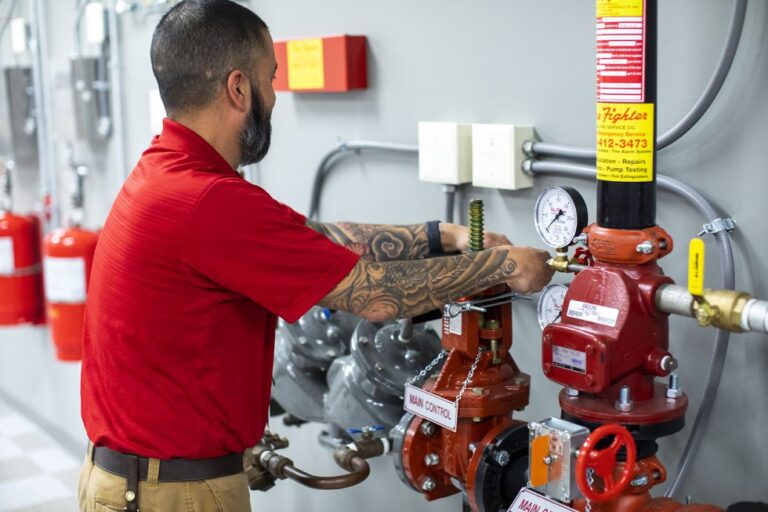
A backflow field test is a differential-pressure test in which a certified tester isolates the assembly, connects a calibrated test kit to the test cocks, and measures whether each check valve and, where fitted, the relief valve still holds to the tolerance CSA B64.10 requires.
The visit is short but not invisible, and the scheduling is the part a property manager needs to control. Water to the line under test is shut off while the assembly is isolated, so a test on the domestic assembly interrupts water to tenants and a test on the fire assembly interrupts the sprinkler system. Both are planned, notified and restored in the same visit. On the fire side the monitoring station is called before the valve is closed and again when it is reopened, and the control valve is confirmed open and secured before the crew leaves, which is the most common way a sprinkler system ends up sitting silently out of service for months.
The building receives a completed test report showing the readings for each check valve and the relief valve, a pass or fail result, and a device tag. Poseidon submits the results to the City of Port Coquitlam on the City’s test form with the applicable fee, as section 27 requires, and returns the filed report for the compliance file described on the fire protection compliance page.
When an Assembly Fails the Test
A failed backflow test is a result showing that a check valve or the relief valve no longer holds pressure to the required tolerance, which means the assembly is not providing the protection the bylaw requires and must be repaired or replaced and then retested.
Failures are mechanical and mundane. The rubber seats and springs inside a check valve wear out. Debris from a watermain break, a hydrant flushing program or upstream construction lodges on a seat and holds it open. An unheated sprinkler room freezes an assembly and cracks the body. A relief valve discharging continuously to the floor drain is not a nuisance; it is the assembly reporting that its first check has failed and doing exactly what it was built to do.
Most failures are repaired in place with a rebuild kit, replacing the seats, springs and o-rings in the affected check or relief valve, and the assembly is retested immediately. Where the body is damaged or the assembly is obsolete it is replaced, and a replaced device starts a fresh annual cycle from its final inspection date. Either way the corrected result has to reach the City on the City’s form, because the bylaw is not satisfied by a repair; it is satisfied by a passing test on file.
Who This Is For in Port Coquitlam
The property owner is the party Bylaw 3710 looks to for a compliant backflow prevention assembly and a filed annual test, regardless of who occupies the building or who signs the invoice.
For a general contractor, the trigger is final inspection: the assembly is tested and filed at the end of the job, and that date starts the clock the owner inherits at turnover. For a property manager, the problem is anniversaries, since a portfolio carries a rolling calendar of due dates and the domestic and fire devices in one building do not necessarily share one. For a strata council, the assemblies are common property and the obligation sits with the strata corporation.
Poseidon Fire Protection is based at #2104 1225 Kingsway Avenue in Port Coquitlam and services commercial, strata and multi-family, and industrial buildings here and across Coquitlam, Port Moody, New Westminster, Burnaby, Maple Ridge, Surrey, Langley and the rest of Metro Vancouver and the Fraser Valley. Requirements differ by municipality, because backflow is enforced by each city’s own cross-connection control bylaw rather than by the fire code; Surrey’s are set out on the Surrey backflow testing page.
Frequently Asked Questions
How often does a backflow device have to be tested in Port Coquitlam?
Annually. Port Coquitlam Bylaw No. 3710, section 27, requires all backflow prevention devices to be tested annually, with the cycle commencing on the final inspection date for the device. Because the anniversary is tied to each device, a building with several assemblies can carry several different due dates in the year.
Does the backflow assembly on the fire sprinkler line need to be tested too?
Yes. Section 27 of Bylaw 3710 applies to all backflow prevention devices, and the assembly on the fire service connection, typically a double check detector assembly or a reduced pressure detector assembly, is one of them. It sits upstream of the sprinkler riser, so testing it takes the sprinkler system out of service and must be handled as a planned impairment.
Who is allowed to test a backflow preventer in Port Coquitlam?
A certified tester. Bylaw 3710 requires that a certified tester complete the annual test and submit the results to the City of Port Coquitlam on the City’s test form with the applicable fee. The test itself is a differential-pressure measurement taken at the assembly’s test cocks with a calibrated test kit.
What happens if the test results are never filed with the City?
The obligation is not met. Section 27 requires the results to be submitted to the City of Port Coquitlam on the City’s test form with the applicable fee, so a test that was performed but never filed leaves the device recorded as untested. Poseidon files the report with the City and returns the filed copy for the building’s compliance record.
Will testing the backflow assembly shut off the water or the sprinklers?
Yes, for the duration of the test on that line. Isolating the assembly stops flow through the connection it protects, so a domestic test interrupts water to the building and a fire service test puts the sprinkler system temporarily out of service. Both are scheduled in advance, the monitoring station is notified before the fire line valve is closed, and the valve is confirmed open and secured before the crew leaves.
What is involved in repairing an assembly that fails?
Most failed assemblies are repaired in place with a rebuild kit that replaces the seats, springs and o-rings in the affected check or relief valve, and are retested the same visit. A cracked or obsolete body is replaced instead, which restarts the annual cycle from the new device’s final inspection date. Poseidon quotes the repair against the failed test report before any work proceeds.
Related Fire Protection Services
The assembly on the fire service connection feeds the same pipe as your sprinkler system, which is why the two belong in one shutdown and on one report. The wider testing obligation is described under backflow prevention and the annual cycle under fire inspections and ITM, with the codes and bylaws behind all of it on fire protection compliance in British Columbia.
Qualified, Insured, Prequalified
Poseidon Fire Protection is an ASTTBC-registered fire protection contractor whose sprinkler fitters hold Red Seal certification.
Areas We Service
Poseidon Fire Protection is a Port Coquitlam fire protection contractor serving commercial, strata and industrial properties across Metro Vancouver, the Fraser Valley and the Sea to Sky corridor.
- Metro Vancouver: Vancouver, Burnaby, Surrey, Richmond, Coquitlam, Port Coquitlam, Port Moody, New Westminster, North Vancouver, Delta
- Fraser Valley: Langley, Maple Ridge, Abbotsford
- Sea to Sky: Squamish, Whistler, Pemberton

Book the annual backflow test and the sprinkler shutdown together
Send the building address and the assemblies on site, and Poseidon returns a scheduled test date, a planned impairment window for the fire service connection, a completed test report for each device, and the filing with the City of Port Coquitlam on the City’s test form.