




Warehouse & Distribution
Warehouse & Distribution Fire Sprinkler Systems
A warehouse fire sprinkler system is a water-based fire protection system designed around what is stored inside the building (the commodity class, the storage height, the rack configuration and the clearance to the ceiling) rather than around floor area alone. In a warehouse the fire is in the racking, not on the floor, and the system has to reach it. Poseidon Fire Protection designs, installs and commissions ESFR, in-rack and dry sprinkler systems for the general contractors and industrial developers building distribution space across Metro Vancouver and the Fraser Valley.
Commodity Classification and Storage Height Drive the Design
Commodity classification is NFPA 13’s ranking of stored goods by how much heat they release when they burn: from Class I non-combustible product on a wood pallet, up through Class IV, and on to the plastics groups that burn hottest and fastest.
Classification, storage height, rack configuration, aisle width, clearance to the ceiling and whether product is encapsulated are the inputs that produce a warehouse sprinkler design. Change one and the design changes: density, head type, K-factor, pipe sizing and the water supply required at the base of the riser. A building designed for palletised Class III product at moderate height does not automatically protect a tenant who arrives with Group A plastics stacked higher, which is why a developer building on spec should know exactly which design envelope they are buying.
High-piled storage (product stored above the height at which the BC Building Code and NFPA 13 stop treating it as ordinary storage) brings its own plan review with the authority having jurisdiction. The AHJ wants a storage plan showing commodity, height, rack layout and flue spaces, compared against the sprinkler design before the permit issues. Poseidon prepares that package for the general contractor.
What drives a warehouse sprinkler design
- Commodity class: Class I through Class IV, and Group A/B/C plastics
- Maximum storage height and clearance to the ceiling
- Rack configuration: single-row, double-row, multi-row, solid-shelf, drive-in
- Aisle width, flue spaces and whether product is encapsulated
- Available water supply, and whether a fire pump is needed to reach design pressure
ESFR: Early Suppression Fast Response
ESFR is a class of large-orifice, fast-responding ceiling sprinkler designed to suppress a storage fire outright rather than merely control it, discharging droplets heavy enough to drive down through the fire plume and wet the burning commodity.
The commercial appeal of ESFR is not the head: it is what the head lets you leave out. Within its design envelope, an ESFR ceiling system can protect high-piled storage without in-rack sprinklers. For a logistics tenant that means racking can be reconfigured without a sprinkler contractor, forklifts cannot shear off in-rack branch lines, and the rack layout is not pinned to a pipe grid. Developers building speculative distribution space in Surrey and Langley increasingly specify it for that flexibility alone.
ESFR is demanding in return: a wet system, a ceiling within a defined height range, controlled clearance above storage, an obstruction-free ceiling plane, and a water supply capable of high flow at high pressure, usually a fire pump to NFPA 20 and sometimes a dedicated storage tank. Poseidon establishes early whether the site’s water service can support ESFR at all, because that answer moves the whole building’s mechanical budget.
In-Rack Sprinklers and the Buildings ESFR Cannot Protect
In-rack sprinklers are sprinkler heads installed inside the storage racks at intermediate levels, attacking a fire within the rack before it develops beyond what a ceiling-only system can handle.
In-rack protection is the fallback when the storage arrangement sits outside the ESFR envelope: solid-shelf racking that blocks water from falling through, encapsulated plastics, storage too high or too close to the ceiling, drive-in racking, or an existing building whose roof height and water supply were never designed for ceiling-only suppression. The system is built from branch lines run within the rack uprights, heads fitted with water shields, and transverse and longitudinal flue spaces that must be kept clear for the design to work.
The trade-off is operational: in-rack piping is exposed to forklift impact, must be guarded, and ties the racking layout to the sprinkler layout; racks cannot move without a sprinkler alteration and usually a permit. Poseidon lays that out at design stage, because it is cheaper to argue about roof height and fire pumps on paper than to retrofit in-rack sprinklers into a leased building.
Dry Systems, Antifreeze Loops and Cold Storage
A dry pipe sprinkler system is a sprinkler system whose piping holds pressurised air or nitrogen instead of water, with the water held back at a dry pipe valve until a head opens and the air escapes.
Anywhere the pipe can freeze, the pipe cannot hold water: unheated warehouse space, loading docks, canopies, parkades and freezer rooms. The dry system solves that at a cost. Water delivery is delayed, so the design area is enlarged to compensate, and the system carries components a wet system does not: an air compressor, a dry pipe valve, an accelerator, pitched piping, low-point drains, and a corrosion strategy, because wet-dry cycling inside steel pipe eats dry systems from the inside. Nitrogen in place of compressed air is the usual answer.
Cold storage is the sharpest version of the problem, and it is tightening in Richmond and Delta as food and pharmaceutical distribution expands. Small unheated pockets hanging off a wet system (a dock canopy, a vestibule) can sometimes be handled with a listed antifreeze loop instead, within the limits NFPA 13 places on antifreeze solutions.
The Surrey and Port Kells Industrial Corridor
The Surrey–Port Kells corridor is the concentration of distribution, logistics and light industrial construction that runs along Metro Vancouver’s eastern highway and rail infrastructure, extending into Langley, Delta and Abbotsford.
That corridor is where industrial fire protection money is, and Poseidon works from 1225 Kingsway Avenue in Port Coquitlam: the same side of the region, close enough to mobilise a crew to a Surrey or Langley tilt-up without an hour of highway on every timesheet. The buyer is the general contractor or the industrial developer, and the deliverable is a sprinkler package that survives the AHJ’s plan review the first time.
Surrey also has one of the region’s more explicit cross-connection control bylaws, and it catches general contractors out. Its bylaw requires premise isolation backflow preventers on each of the domestic, fire and irrigation service connections for new construction, and alterations valued at $400,000 or more trigger premise isolation on all three. Assemblies must be field tested annually, and tested within 14 days of a new installation or replacement, by a tester holding BCWWA certification. Offences carry fines of not less than $100 and not exceeding $10,000, with separate fines for each day the offence continues. Poseidon installs and tests those assemblies as part of the fire service scope.
What the General Contractor Receives at Turnover
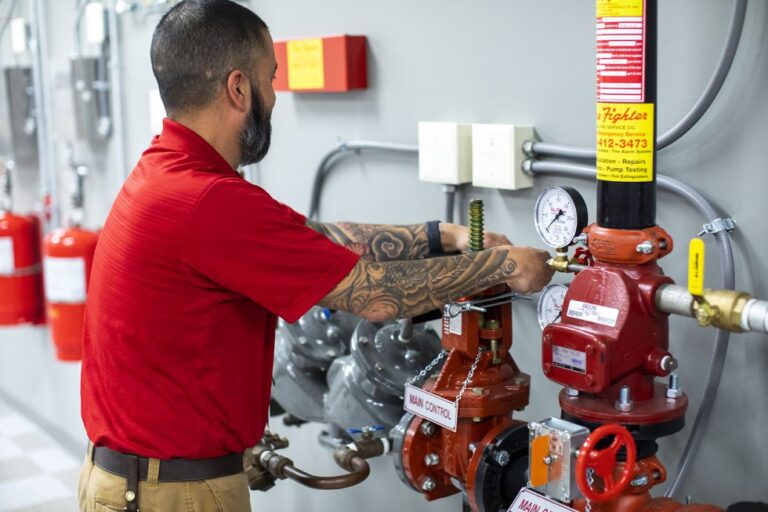
Turnover on a warehouse sprinkler package is the complete evidentiary record that the installed system matches the permitted design: hydraulic calculations, sealed shop drawings, test certificates, as-builts and the AHJ’s final sign-off.
The sequence is fixed: hydraulic calculation and shop drawings, permit submission and AHJ review, underground work and the fire department connection, the fire pump if the design needs one, above-ground installation by Red Seal–certified sprinkler fitters, hydrostatic testing, flushing, the main drain test, and commissioning witnessed by the AHJ. Then the paperwork (contractor’s material and test certificate, as-built drawings, O&M manuals) and handover into an inspection, testing and maintenance program under NFPA 25.
Poseidon is ASTTBC-registered and COR certified, carries WorkSafeBC coverage in good standing, and holds commercial general liability insurance and bonding capacity; a certificate of insurance and clearance letter is provided on request, which is what a GC’s prequalification package asks for. The company has built this work since 2019 across Surrey, Langley, Delta, Richmond, Abbotsford, Coquitlam and Maple Ridge.
Rack Changes and Tenant Fit-Outs After Occupancy
A rack reconfiguration is any change to storage height, rack layout, aisle width or commodity class that alters the fire scenario the sprinkler system was originally designed to handle.
Warehouses do not stay as designed. A tenant raises storage a metre, switches from cardboard to plastic totes, installs a mezzanine, adds solid shelving or narrows an aisle, and the permitted sprinkler design no longer matches the building’s contents. That is a live compliance exposure for the landlord and an insurance exposure for the tenant, and it surfaces at the worst moment: during an inspection, or during a claim. Poseidon re-evaluates the design against the new storage arrangement, tells the property manager or the tenant’s general contractor whether the existing system still covers it, and prices the alteration if it does not.
Frequently Asked Questions
What is the difference between ESFR and in-rack sprinklers?
ESFR is a ceiling-mounted, large-orifice sprinkler designed to suppress a storage fire from above, while in-rack sprinklers are heads installed inside the racking itself to attack a fire at its source. Within its design envelope, ESFR can protect high-piled storage without in-rack piping, which leaves the racking free to be reconfigured and out of reach of forklift damage. In-rack protection becomes necessary when storage height, solid-shelf racking, encapsulated plastics or an inadequate water supply puts the building outside what ESFR can do.
Our tenant is storing plastics. Does the existing sprinkler system still cover it?
Not necessarily: commodity class is one of the primary inputs to a warehouse sprinkler design, and Group A plastics release far more heat than the Class I to Class III commodities most spec buildings are designed around. A change in commodity, storage height or rack configuration can put a building outside its permitted design. Poseidon reviews the existing hydraulic design against the actual storage arrangement and confirms in writing whether it still holds.
Do we need a dry system for an unheated warehouse or freezer?
A dry pipe sprinkler system is required wherever piping is exposed to freezing temperatures (unheated warehouse space, loading docks, canopies, parkades and cold storage rooms) because a wet system’s water would freeze and split the pipe. Dry systems add an air compressor, a dry pipe valve, pitched piping, low-point drains and a corrosion strategy, and they enlarge the design area to account for water delivery delay. Small unheated pockets off a wet system can sometimes be handled with a listed antifreeze loop instead.
Who handles the high-piled storage submission to the AHJ?
The high-piled storage package is a plan review submission showing commodity class, storage height, rack layout and flue spaces, checked by the authority having jurisdiction against the building’s sprinkler design. Poseidon prepares it alongside the sprinkler shop drawings for the general contractor, so the storage plan and the hydraulic design arrive at the AHJ as one consistent story rather than two contradictory ones.
Does a new warehouse in Surrey need backflow prevention on the fire line?
Yes. Surrey’s Cross Connection Control By-law requires premise isolation backflow preventers on each of the domestic, fire and irrigation service connections for new construction, and alterations valued at $400,000 or more trigger premise isolation on all three. Assemblies must be tested within 14 days of a new installation or replacement and field tested annually by a tester holding BCWWA certification. Poseidon installs and tests the assembly on the fire service as part of the sprinkler scope.
Will the building need a fire pump?
A fire pump is required whenever the municipal water supply cannot deliver the flow and pressure the sprinkler design demands at the base of the riser, common for ESFR systems, because ESFR trades in-rack piping for high flow at high pressure. The answer comes out of a flow test on the site’s water service and the hydraulic calculation for the proposed storage. Poseidon establishes it early, because a fire pump, its room, its power supply and its controller are a building-wide cost, not a sprinkler line item.
Related Fire Protection Services
A warehouse package rarely stops at the sprinkler heads. The same scope usually carries backflow prevention on the fire and domestic services, a fire alarm system supervising the waterflow and tamper switches, and emergency lighting along the egress routes of a very large floor plate. Once occupied, the building moves onto scheduled inspection, testing and maintenance under NFPA 25, and any change to the racking becomes sprinkler alteration work. See our credentials for the prequalification documents most general contractors ask for.
Qualified, Insured, Prequalified
Poseidon Fire Protection is an ASTTBC-registered fire protection contractor whose sprinkler fitters hold Red Seal certification.
Areas We Service
Poseidon Fire Protection is a Port Coquitlam fire protection contractor serving commercial, strata and industrial properties across Metro Vancouver, the Fraser Valley and the Sea to Sky corridor.
- Metro Vancouver: Vancouver, Burnaby, Surrey, Richmond, Coquitlam, Port Coquitlam, Port Moody, New Westminster, North Vancouver, Delta
- Fraser Valley: Langley, Maple Ridge, Abbotsford
- Sea to Sky: Squamish, Whistler, Pemberton

Send Us the Storage Plan
Give Poseidon the architectural drawings, the racking layout and the commodity the tenant intends to store, and you get back a design approach (ESFR, in-rack, dry or a combination) with a hydraulic strategy, a view on whether a fire pump is needed, and a priced scope for permit, installation and commissioning. For general contractors and industrial developers in Surrey, Langley, Delta and Abbotsford: certificate of insurance and clearance letter provided on request.