




Fire Alarm Installation
Fire Alarm System Installation and Verification
A fire alarm system is a life safety system that detects fire, warns occupants and summons the fire department, and supervises its own wiring continuously so that a fault in the system is reported before it can matter. Poseidon Fire Protection installs fire alarm systems to CAN/ULC-S524 and delivers the CAN/ULC-S537 verification report a general contractor needs before occupancy, for commercial, strata and industrial buildings across Metro Vancouver, the Fraser Valley and the Sea to Sky. Device layout, permit, rough-in, panel programming, verification and a deficiency list walked to zero – handed over as one package.
The Parts of a Fire Alarm System
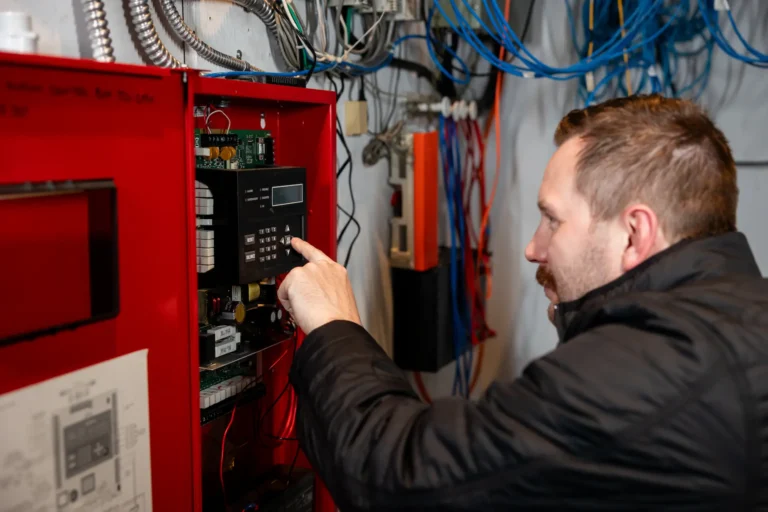
A fire alarm system is a supervised circuit joining initiating devices, a fire alarm control panel and notification appliances, so that every detector, every pull station and every conductor between them is continuously monitored for fault.
The fire alarm control panel is the system. It monitors every circuit and separates what it hears into three distinct signal types: alarm, supervisory and trouble. The annunciator at the main entrance is what the first-arriving firefighter reads, and it is the reason device labelling is not a cosmetic detail. Initiating devices feed the panel: smoke detectors, heat detectors for spaces where smoke detection would nuisance-alarm, duct detectors in the HVAC airstream to shut a fan down so it cannot distribute smoke through the building, manual pull stations at the exits, and the sprinkler system’s own waterflow and tamper switches.
On the output side, notification appliances tell occupants: horns, strobes and combination horn-strobes, or speakers where a voice communication system is installed. An end-of-line device terminates each conventional circuit so that a broken conductor produces a trouble signal rather than silence – the difference between a system that knows it is injured and one that does not. Addressable modules bring conventional devices and dry contacts onto an addressable loop, and battery backup carries the panel through a power failure.
Devices we install, program and verify
- Fire alarm control panel and remote annunciator
- Smoke detectors, heat detectors and duct detectors
- Manual pull stations
- Horns, strobes and voice communication speakers
- End-of-line devices and addressable modules
- Sprinkler waterflow and valve tamper switch interconnection
- Sealed battery backup and charger
Conventional, Addressable, Single-Stage, Two-Stage and Voice
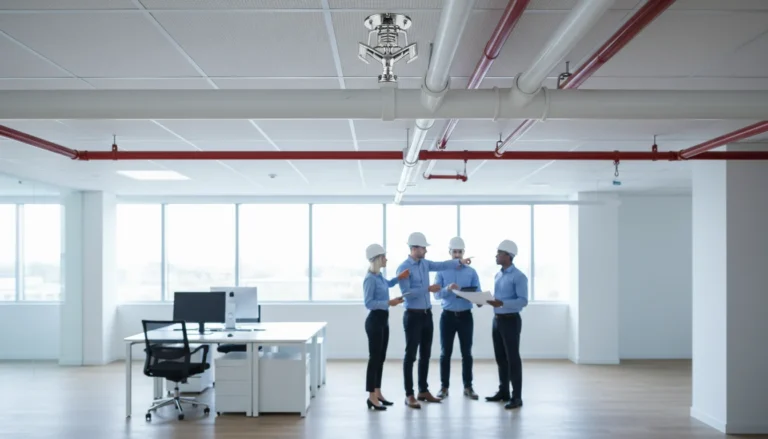
A conventional fire alarm system reports by zone – an alarm somewhere in this area of the building – while an addressable fire alarm system reports by device, naming the exact detector that operated and where it is.
On an addressable system every device carries an address, so the panel and the annunciator name it. That shortens the fire department’s search, it lets a building operator find the one dusty detector causing nuisance alarms instead of walking a whole zone, and it makes future tenant improvements cheaper to extend. Conventional systems still make sense in small buildings where zones are few and obvious. The distinction is decided at design, because it determines the panel, the wiring topology and the device count – it is not a field substitution.
Signalling stage is a separate axis. A single-stage system sounds a general alarm throughout the building at once and everyone evacuates. A two-stage system sounds an alert signal first, giving supervisory staff a defined window to investigate before the general alarm sounds, which is why it is common in high-rise residential and institutional buildings where a total simultaneous evacuation is itself a hazard. A voice communication system replaces horns with speakers so that a live or recorded message can direct a floor-by-floor response. Which of these your building requires is a Building Code function of height, occupancy and area, and it is settled before rough-in.
CAN/ULC-S524: How the System Is Installed
CAN/ULC-S524 is the Canadian installation standard for fire alarm systems, governing where devices are located and spaced, how circuits are wired and supervised, and how the panel interconnects with the rest of the building.
A fire alarm system is not just detectors and horns; the panel is the hub the rest of the building’s life safety systems hang off. Elevator recall sends cars to a designated level and holds them there. Duct detectors shut down air handling so the HVAC system does not become a smoke distribution system. Magnetic door hold-opens release so fire separations actually separate. Where a fire pump or smoke control is present, the panel supervises and reports it. Each of these interconnections is a wire, a module, a programming line and a test – and each is a thing that can be installed and never proved.
The sprinkler interface is where the two trades meet. Every waterflow switch and every valve tamper switch on the sprinkler system terminates at the fire alarm panel: waterflow is programmed as an alarm, tamper as a supervisory signal. Reverse them and a closed sprinkler valve either evacuates the building or, far worse, reports nothing at all. Poseidon installs both the sprinkler system and the fire alarm system, so that interconnection is wired, programmed and tested end to end by one contractor instead of being argued about by two.

CAN/ULC-S537 Verification vs CAN/ULC-S536 Inspection
CAN/ULC-S537 verification is a one-time, whole-system proof that a newly installed or modified fire alarm system was built as designed and performs as designed, and the BC Building Code requires it before the building can be occupied.
These two standards are routinely confused, and the confusion costs occupancy dates. Verification to CAN/ULC-S537 is a construction deliverable, bought by the general contractor. Every device is tested, every circuit is proved, every interconnection – elevator recall, fan shutdown, door hold-open release, sprinkler waterflow and tamper – is demonstrated, and the output is a signed verification report stating what was tested and confirming that the deficiencies found were corrected. It is required when a system is new, and again when a system is extended or modified, which means a tenant improvement that adds detectors and relocates a pull station triggers verification of the affected work.
CAN/ULC-S536 is the recurring inspection and testing standard referenced by the BC Fire Code. It is the annual fire alarm inspection, and it is the owner’s obligation for the rest of the building’s life: devices tested, batteries load-tested, panel functions confirmed, deficiencies listed and reported. The distinction that matters at handover is blunt. An inspection report is not a verification report, and an authority having jurisdiction will not accept one in place of the other. General contractors discover this late – the building is finished, the fire alarm is working, and occupancy is held because nobody scoped a verification.
The difference in one line each
- CAN/ULC-S537 – verification. Once, at commissioning and again after any modification. Required by the BC Building Code before occupancy. Bought by the general contractor.
- CAN/ULC-S536 – inspection and testing. Recurring, for the life of the building. Referenced by the BC Fire Code. Owned by the building owner, property manager or strata.
- A verification report proves the system was installed correctly. An inspection report proves it is still working.
- Neither substitutes for the other, and the AHJ will ask for the right one.
Commissioning: From Rough-In to Occupancy
Commissioning a fire alarm system is the sequence that runs from permitted device layout drawings through rough-in wiring, panel programming and point-to-point testing to a signed verification report and AHJ acceptance.
It starts on paper: device layout drawings, riser diagram, battery calculation and sequence of operation, submitted for permit. Rough-in follows the building – conduit and conductors before walls close, backboxes set where the drawings say and not where the ceiling happened to land. The panel is installed, addressed and programmed, and then every point is proved individually: each detector operated, each pull station pulled, each notification appliance confirmed, each interconnection demonstrated to actually do the thing it is programmed to do.
Verification is the gate. Deficiencies found during verification are listed, corrected and re-verified until the list is at zero, and only then is the report signed. Poseidon schedules that verification against the general contractor’s occupancy date rather than after it, walks the deficiency list closed, and turns over the report together with the as-built device layout, the panel programming record, the battery calculation, the operating instructions and the monitoring handover – the package an owner needs before the first CAN/ULC-S536 annual inspection is even due.
Who Fire Alarm Installation Is For
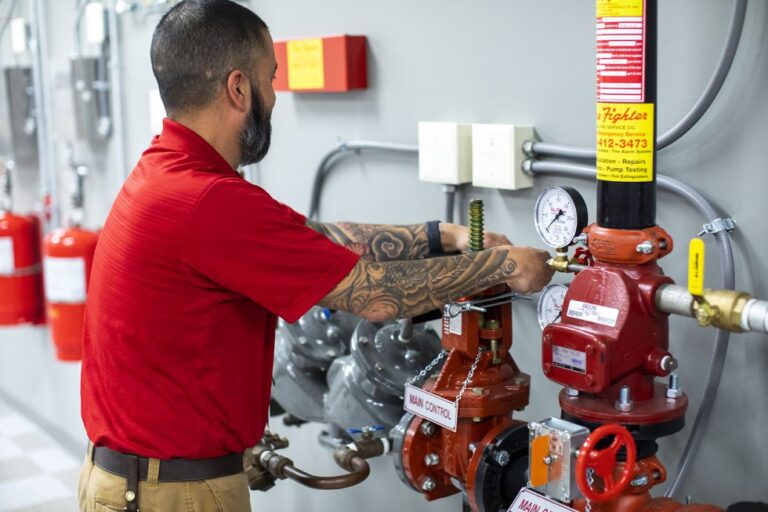
The buyer of a fire alarm installation is the general contractor or developer who needs occupancy, and then the property manager or strata council who inherits the panel, its annunciator and its trouble signals for the life of the building.
For general contractors and developers, the fire alarm system is on the critical path to occupancy in a way few other trades are, because the verification report is a document the AHJ asks for by name. For property managers and strata councils, the common project is a retrofit: an obsolete panel whose modules are no longer manufactured, a conventional system being taken addressable, a building adding voice communication, or a system that has accumulated so many undocumented tenant-improvement changes that nobody can say with confidence what is on which circuit. For industrial owners, it is duct detection, high-ceiling heat detection and interconnection with process shutdowns.
Poseidon Fire Protection has operated from Port Coquitlam since 2019 and works across Vancouver, Burnaby, Surrey, Richmond, Coquitlam, Port Moody, New Westminster, Langley, Maple Ridge, Delta, North Vancouver and Abbotsford, and up the Sea to Sky to Squamish, Whistler and Pemberton. Our technical staff are ASTTBC-registered, we are COR certified, our WorkSafeBC coverage is in good standing, and we carry commercial general liability insurance and bonding capacity – certificate of insurance and clearance letter provided on request. Associa, Bosa Properties, FirstService and Marcon are among the organizations we work with.
How Fire Alarm Systems Fail
A fire alarm system in trouble is not a system in alarm – a trouble signal means the panel has lost supervision of a device or a circuit, and a system that cannot see a device cannot report what that device sees.
Ground faults come from a nicked conductor or water in a junction box. Open circuits come from a removed or defeated end-of-line device, which is precisely the component that makes supervision work. Batteries age out quietly and then fail to carry the panel through the power outage they exist for. During construction, smoke detectors fill with drywall dust and nuisance-alarm until someone bags them – and a bagged detector that is never unbagged before verification is a detector that will not operate in a fire.
The structural failure is documentation. A tenant improvement adds devices, moves a pull station, re-zones a floor, and the system is never re-verified and the as-builts are never updated; three renovations later, the panel’s programming and the building no longer describe each other. Every one of these conditions produces a signal on the annunciator. The failure is not that the system stayed silent – it is that nobody acted on what it said.
Frequently Asked Questions
What is the difference between CAN/ULC-S537 verification and CAN/ULC-S536 inspection?
CAN/ULC-S537 verification is a one-time proof that a new or modified fire alarm system was installed and performs as designed; it is a Building Code requirement at commissioning and is normally bought by the general contractor before occupancy. CAN/ULC-S536 is the recurring inspection and testing standard referenced by the BC Fire Code, and it is the building owner’s ongoing obligation. An inspection report will not be accepted in place of a verification report.
Do we need a fire alarm verification before we can occupy the building?
Yes. A newly installed fire alarm system must be verified to CAN/ULC-S537 before occupancy, and the authority having jurisdiction will ask for the signed verification report. It is one of the most common reasons an otherwise finished building is held at occupancy, because the system works, the trades are gone, and nobody scoped the verification.
Does a tenant improvement require a new verification?
If the tenant improvement extends or modifies the fire alarm system – adding detectors, relocating pull stations, re-zoning a floor – the affected work requires verification to CAN/ULC-S537. Verification is not only a new-building activity, and skipping it on a TI leaves the panel’s programming and the as-built drawings describing a building that no longer exists.
Should we install a conventional or an addressable fire alarm system?
An addressable system reports by individual device and a conventional system reports by zone. Addressable is the practical choice for most commercial and multi-family buildings because it names the exact device in alarm or in trouble, which shortens the fire department’s search and makes future tenant improvements cheaper to extend. The decision is made at design because it determines the panel, the wiring and the device count.
What is a two-stage fire alarm system?
A two-stage fire alarm system sounds an alert signal first, giving supervisory staff a defined window to investigate before the general alarm sounds throughout the building. It is common in high-rise residential and institutional buildings, where evacuating everyone simultaneously is itself a hazard. Whether your building requires single-stage, two-stage or a voice communication system is determined by its height, occupancy and area.
Who wires the sprinkler waterflow and tamper switches?
They are sprinkler devices that terminate on the fire alarm control panel, which is exactly why they get missed – each trade assumes the other owns them. Waterflow is programmed as an alarm signal and valve tamper as a supervisory signal. Poseidon installs both the sprinkler system and the fire alarm system, so the interconnection is wired, programmed and tested end to end by one contractor.
Related Fire Protection Services
The fire alarm panel is where the rest of the building reports in, so it is rarely bought alone. Sprinkler waterflow and valve tamper switches installed under fire sprinkler installation terminate on this panel, exit and egress lighting is proved alongside it under emergency lighting, and once the CAN/ULC-S537 verification is signed the system moves onto the CAN/ULC-S536 cycle we deliver as fire inspections and ITM. A panel sitting in trouble or a system in false alarm is an emergency service call.
Qualified, Insured, Prequalified
Poseidon Fire Protection is an ASTTBC-registered fire protection contractor whose sprinkler fitters hold Red Seal certification.
Areas We Service
Poseidon Fire Protection is a Port Coquitlam fire protection contractor serving commercial, strata and industrial properties across Metro Vancouver, the Fraser Valley and the Sea to Sky corridor.
- Metro Vancouver: Vancouver, Burnaby, Surrey, Richmond, Coquitlam, Port Coquitlam, Port Moody, New Westminster, North Vancouver, Delta
- Fraser Valley: Langley, Maple Ridge, Abbotsford
- Sea to Sky: Squamish, Whistler, Pemberton

Scope your fire alarm installation and verification together
Send your drawings or your existing panel details and Poseidon Fire Protection will return a scoped quote covering device layout, permit, rough-in, panel programming and the CAN/ULC-S537 verification – priced as one package so the verification report is in your hands before your occupancy date, not after it. You receive the signed verification report, as-built device layout, panel programming record and turnover documentation. Certificate of insurance and WorkSafeBC clearance letter provided on request.